Sweeney Center
-
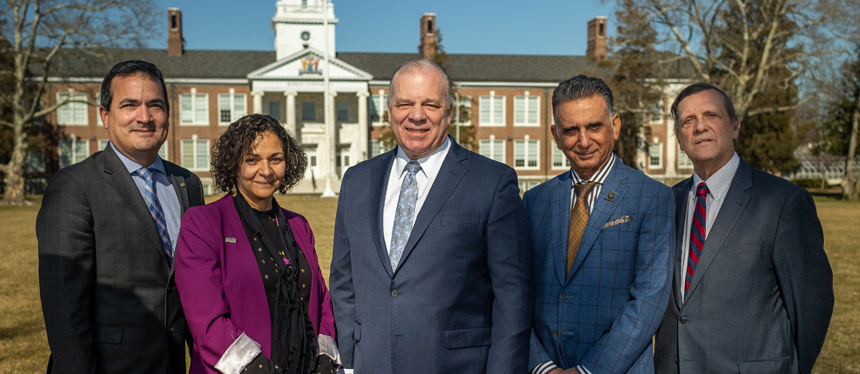 Left to Right: Tony Lowman, Nawal Ammar, Steve Sweeney, Ali Houshmand, Mark Magyar
Sweeney Center
Greater Paulsboro Energy Companies generate $814M in economic output, support 2,855 jobs
Sweeney Center study highlights GPEC as a major driver of the regional economy
Oct. 8, 2026 - The Greater Paulsboro Energy Companies (GPEC) generate nearly $814 million in total economic output and support 2,855 jobs, making it a major driver of economic activity in Gloucester County, according to a new study by the Steve Sweeney Center for Public Policy at Rowan University.
GPEC accounts for nearly one-third (30.7%) of the combined economy of Paulsboro, Greenwich and West Deptford and supports roughly one in six jobs across the three municipalities.
Investment in South Jersey
Beyond supporting jobs, GPEC provides a significant source of tax revenue, wages and capital investment that reaches communities throughout South Jersey.
GPEC generates approximately $22.6 million in local tax revenue, helping fund public schools, emergency services and municipal infrastructure. GPEC also generated $265.9 million in labor income and contributed $437.8 million in value to New Jersey’s economy.
Additionally, more than $53.8 million has been invested in capital investments, including the redevelopment of the Repauno site, storage cavern expansions and terminal improvements.
Strategic Regional Asset
GPEC comprises the Paulsboro Refining Company, CPI Operations, PBF Logistics Products Terminal Paulsboro, ExxonMobil Lubes Plant, Repauno Port & Rail Terminal, Sunoco Property and Energy Transfer Eagle Point Terminal.
Together, these facilities occupy a strategic location along the Delaware River with access to railroads and the I-295 and I-95 corridors serving markets throughout the Northeast and Mid-Atlantic regions.
Download the Economic Impact Analysis Report
The Steve Sweeney Center for Public Policy
Welcome to the Sweeney Center. The policy center was created to fill the need for an independent bipartisan public policy center to conduct research and develop pragmatic solutions to complex policy issues based on data-driven analysis, rigorous academic research, and convening working groups that bring together policy experts, stakeholders and advocates to reach consensus.
The Sweeney Center's first major policy project was the creation of the Multi-Year Budget Workgroup, an independent bipartisan group of former Cabinet officers, legislators, budget officials, economists and policy experts convened to develop consensus five-year revenue and expenditure projections to inform the Governor, Legislature and the public. The Multi-Year Budget Workgroup issued multi-year budget projections New Jersey's Fiscal Future in June 2022, New Jersey's Fiscal Future II in June 2023 and most recently New Jersey's Fiscal Cliff on February 13, 2024.
The Sweeney Center has taken a leadership role in the public policy debate on Offshore Wind and emerging clean energy technologies. Sweeney Center Director Mark Magyar authored Benchmarking New Jersey's Offshore Wind Initiatives in June 2023, and the Sweeney Center hosted conferences on Offshore Wind Technology in New Jersey: Sustainability, Emerging Markets and Technology in May 2023, The Road to Zero Emissions: The Future of Hydrogen and Nuclear Energy in New Jersey in October 2023, and Moving Forward on Offshore Wind: New Challenges, New Competition this February.
The Sweeney Center collaborated with the Rowan College of Education to create the Rowan School Regionalization Institute to recommend policies to advance PK-12 regionalization and conduct regionalization studies for interested districts. The Rowan School Regionalization Institute hosted a February 2024 conference on School Regionalization in New Jersey: Issues, Opportunities and Challenges, and the Sweeney Center hosts joint panels on Shared Services and Regionalization with the NJ Division of Local Government Services each year at the NJ League of Municipalities and NJ Association of Counties conventions.
The Sweeney Center is part of Rowan University’s College of Humanities & Social Sciences and is located in Triad Hall, Suite 12B, on Rowan's Glassboro campus. To reach the Sweeney Center, call (856) 256-5868 or email sweeneycenter@rowan.edu. To reach Mark Magyar, the Sweeney Center’s Director, email magyarm@rowan.edu.
Follow us on Twitter at @SweeneyCenterR
Multi-Year Budget Workgroup Report Warns of Upcoming Fiscal Cliff
New Jersey faces a significant fiscal cliff over the next four years, with revenues projected to fall billions of dollars short of the amounts needed to maintain current state services and fund state aid and property tax relief programs at promised levels, according to the latest report by the bipartisan Multi-Year Budget Workgroup convened by the Sweeney Center.
New Jersey’s Fiscal Cliff: Current Budget Services Budget Projections, Long-Term Economic Forecast, and the Five-Year Revenue Gap projects that “there is an 80% likelihood that state revenues will fall $3.2 billion to $7.1 billion short of the amount needed to continue state programs and state aid at current service levels each budget year from FY25 to FY28.
Even under the most optimistic scenario, state revenues will fall $1.9 billion to $3.1 billion short annually.” The state is projected to enter Fiscal Year 2025, which begins July 1, with a near-record $8.2 billion budget surplus, but that cushion would be quickly eaten away, according to the report issued February 13.