Elizabeth Bunce Daly
Elizabeth Bunce Daly
“A Lovely Man”: Elizabeth Bunce Daly on Her Father, Lester Bunce
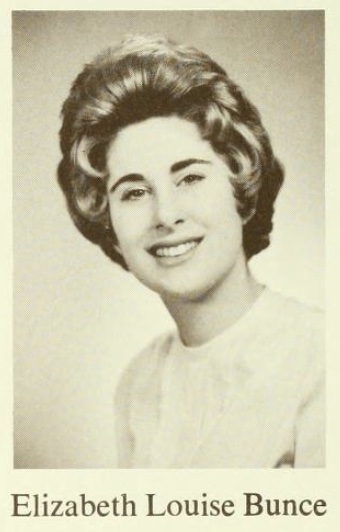
This week’s Project 100+ memory comes from Elizabeth Bunce Daly. On December 16, 1941, days after the attack on Pearl Harbor, she was born in Morristown, New Jersey. At the time, her father, Lester Bunce, was working as a junior high school teacher at Summit High School. Her mother, Elizabeth Accurso Bunce, was from a northern New Jersey family that lived near Summit. When Elizabeth was very young, they moved to southern New Jersey where Lester taught at Clayton High School. In 1945, Lester joined the faculty at Glassboro State College where his father, Edgar Bunce, was the President. The family moved to 42 Columbia Avenue in Pitman, New Jersey. One or more of the family would live in that house for the next six decades. Shortly after they moved to Pitman, Lester and Elizabeth had another girl, Marguerite, in 1946. Three years later, in 1949, Wilma, the third child, was born. Elizabeth graduated from Pitman High School in 1960. She then studied secondary education at Glassboro State College with majors in history and English, graduating in 1964. Two weeks after graduating, she got married to a medical student at Temple University named Thomas Daly. She took a job teaching English at Clearview Regional High School. Later, they moved to Philadelphia, and she taught English at Roxborough High School. In 1971, after she became a mother to her first child, Matthew, she didn’t teach or work outside of the home for quite a long time. During this time, she gave birth to two more children, Michael and Allison. At age 50, her husband passed away. Soon after, she tried to reenter the work force, but she had a hard time finding a job as a teacher because jobs in English and history were hard to get at the time. She ended up working in clerical roles at various universities, including a memorable stint with lovely colleagues at Arcadia University. For thirteen years, she worked in the President’s Office at Cabrini University. After leaving this position, she did various part-time jobs, eventually retiring for good at age 73. In her retirement, she visits her children, enjoys cooking, gardening, going to the movies, and spending time with her friends, often on short trips to various interesting sites.
*****
My parents and I lived for a brief time at the Whitney House with my grandparents. It is the first house that I remember, but my memories are somewhat clouded by the fact that I often came back even after we moved out. We were there often to visit, to share meals, and for various family gatherings. I can remember staying overnight with my grandparents on many occasions. I can remember going on such nice walks on the campus during these sleepovers. I called my grandfather “Papa Eddie,” and I called my grandmother, “Ma Judy,” probably because I could not say Julia when I was very young. Some of my earliest memories of Papa Eddie involved him working in his garden, which he dearly loved. He planted corn, asparagus, string beans, tomatoes, and many other crops. He was a very good farmer and a reserved gentleman. He had grown up on a dairy farm near Fredonia, New York. He loved the Philadelphia Phillies. He used to listen to baseball games on a large radio in his study while smoking small cigars. I can still remember him doing this.
Ma Judy was a warm and lovely person and a great cook. She was a wonderful hostess, and I can remember her hosting teas as well as meals. I still bake cookies very similar to ones she made during the holidays. I was always told by my mother that she was the one that changed the name from the Whitney House to Hollybush Mansion, but I never heard this from her directly.
I didn’t know all that my grandfather had done for the College until I read More than Cold Stone. After reading about his accomplishments, I was very impressed with the work that he had done holding the College together during World War II and the period immediately following, including the near overnight creation of a junior college program for veterans. I was also very proud of what he did regarding civil rights. Although I did not know about the specifics of what he had done at Glassboro State, his interest in this area was not surprising to me because of what he had done after he had retired from Glassboro State College. During this period, which I remember better as I was older, he spent time helping a historically Black College in Florida called Bethune Cookman College.
According to family legend, my parents met when my father came in to check out a book from the Summit Library. They soon fell in love and married in 1939 or 1940. My father was a true gentleman, a reserved and quiet man who liked to read and think and was kind at heart. By contrast, my mother was an outgoing and outspoken daughter of Italian immigrants. As a child, they were opposites to me, but those different personalities must have somehow attracted them to one another.
My father was raised primarily in Trenton while his father, my grandfather, was the Superintendent of the Department of Education. During this time, my father fell in love with kayaking, paddling in and around the city of Trenton. He was also apparently a successful amateur boxer during this period, fighting under the pseudonym “Kid Smith,” due to the fact his father disapproved. At his funeral, his brother, Edgar Jr., told us this story, which was shocking even to his family because boxing seemed so different from his public demeanor. However, I immediately recalled that he always liked boxing. I can remember that one time we drove to the Poconos to see where Muhammad Ali trained. Beyond these hobbies, however, I am sure my father developed an early love of reading and politics as a young man. I can remember him being ever ready to discuss Adlai Stevenson and many other historical topics. To me, he seemed to know so much information and could recite every detail of every President.
My mother was the first of her family born in the United States. Her parents had been born in Italy and had met in New York City. They moved to northern New Jersey where my mother graduated from high school and developed secretarial skills and became a librarian. After she got married, she no longer worked but became a devoted mother. She was a fantastic cook and baker. She was a master of all domestic arts and expertly sewed our clothes. After my father took the job at GSC, she would help out during class registration. Her secretarial skills were valuable during this busy time, and she loved doing this work, often under the Registrar, Grace Bagg. She was also very active in a group that she called the “Faculty Wives” of Glassboro State College. I can’t remember all the things that they did now, but I think they organized clothes drives and things like that. I am pretty certain that they made sure to welcome the wives of newly hired faculty members and helped them adjust. Of course, they also hosted many social outings, teas, and bridge games. I can remember that my parents were part of a rotating dinner club with other faculty and administrators. One family would host the others, and my parents looked forward very much to these evenings. These other families included the Mancusos, the Langworthys, the Boles, the Wilsons, the Pfleegers, the Hitchners, and many others. Another very dear friend of my parents was Hazel Saindon. She was single, and my parents made a determined effort to invite her over for dinner and other social events. Eva Aronfreed was another such individual that I remember.
Although I am sure that my father always wanted to teach at the college level, he had to do several things to be able to apply for such a position. In particular, he needed to finish his master’s degree, which he did at Montclair State College. If he wanted to teach future educators, as he would one day do at Glassboro State College, it was also probably important that he get experience in a classroom himself. His first teaching job was a high school social studies teacher in Summit, New Jersey. Later, he took a similar position at Clayton High School, probably to be close to his parents who were living in Glassboro at the time. In fact, they told me that I even lived with my grandparents in Hollybush for a short period of time. After some time teaching at Clayton, an opportunity became available at Glassboro State College in the Department of Social Studies. My father took the position and would end up teaching there for three decades.
I never had my father as a teacher, but he was great at telling stories and was so knowledgeable about history. He taught the history of Western Civilization quite often, but I think he loved European and American history equally. When he joined the Department of Social Studies, faculty sometimes taught in multiple disciplines, and this was not a problem for him. Indeed, he loved teaching sociology. He was always interested in the latest studies of how different groups interacted. I can remember him becoming fascinated with Normal Vincent Peale when his book became popular in the early 1950s. Later, he gave me a copy of James Allen’s As a Man Thinketh, which was similar in some respects. He wrote a very nice inscription in this book to me.
Teaching was the thing that he had always wanted to do. He assumed that all his children would also become teachers, just like he had done and as his parents had done. He loved his job, and he considered it a noble profession. We had a small home with only one room that might be called an office space. It was a tiny sunroom off the living room. I believe he kept his typewriter there, but I think he did most of his work at the office where they had a mimeograph machine. He did have a large comfy chair and one large bookcase on one side of our living room. I can remember him sitting there reading books and grading papers.
In addition to history, he was always deeply interested in politics. When I was very young, I remember listening along with him to one of the political conventions on the radio. I think this was the 1948 Democratic National Convention, which met in Philadelphia. This love of politics continued as long as he was alive, and he passed it on to me. Like him, I am always following state and national politics.
My father thought very highly of his colleagues, and I can never remember him saying anything negative about any of them. He was very fond of both Harold Wilson and Sam Witchell, who were his senior colleagues. Harold Wilson had hired my father and was a mentor thereafter. I can remember that my father was very supportive of the naming of the new music building after him. This was President Robinson’s idea, but my father believed it was richly deserved. He also felt very close to Sam Witchell as well, and I recently found a letter to me from my father that included a section about Sam’s recent poor turn of health. Another one of his colleagues that he greatly admired was Marvin Creamer. I don’t remember all the details now, but he seemed to talk about him quite a bit. And that was before he became famous for his sailing. Bud Peacock was another person whom my Dad spoke about often. Maury Blanken was a gregarious professor who got along well with my father despite the fact that they had different personalities. I also remember Sid Kessler and Anne Edwards. My father was close to Marius Livingston. They were similar in my mind, very much gentlemen. I think that he and my mother were close to Eva Aronfreed. After I left the house, I think he became close with Ben Hitchner, but he was not on the faculty until my very last year living with my parents.
I have very vivid memories of John F. Kennedy’s assassination. It was my senior year, and I was student teaching at Clearview Regional High School. I was actually in front of the class and teaching when the principal came in over the public address system and said, “We have sad news. The President of the United States has been shot.” I can’t remember exactly what happened next, but I do remember that I began crying. I soon noticed that this was true for many students and teachers as well. Soon, the administration decided to close the school and dismissed everyone. All of us went home and sat around the television watching the events of the next few days together. My entire family was devastated. We were all unabashedly Democratic, but everyone that I knew, no matter their political preferences, was distraught about what happened. It was just so horrible. The time blurs to me now, but it seems like we had the television on all day and all night for several days in a row. No one went to work or school during this period as far as I remember. It seemed like the world stopped. My mother’s parents joined us in our home often during this period. My father’s parents were in Florida, I believe, at the time. In an event, we were watching the funeral together, and I can remember we were all watching when Jack Ruby shot Lee Harvey Oswald live on television.
Although I had graduated from college and was married, I can remember very well the Summit between Lyndon Johnson and Alexei Kosygin. At the time, I think I was living in Germantown and teaching high school at Roxborough while my husband was a medical student at Temple University. I learned about the Summit from the television news. My father also called to make sure I had seen the news. He was so excited about what was happening. We were all so excited since my family had so much history in Hollybush. I knew that I wanted to be there for the meeting. Unfortunately, so many people had the same idea. The crowd was gigantic, and we couldn’t get that close. Still, it was a wonderful time for the town and the College. We were all so proud that Glassboro State College had been chosen for the Summit. I thought that the College and those organizing the meeting handled things very well. I can remember being shocked by the sheer number of reporters and their many, many news trucks. I am sure that this Summit put Glassboro State College on the map for many years and helped grow the College’s identity. However, I don’t think it had the same transformative impact as did Henry Rowan’s gift twenty-five years later.
At the time, I didn’t think anything dramatic about my father’s retirement, which took place in the 1970s after about three decades of service to Glassboro State College. However, later, I thought that his decision might have been prompted by his development of anemia, which began to weaken his physical endurance. Over the next decade or so, the anemia grew slowly worse. Eventually, he developed leukemia, from which he died. However, this was a gradual process and during his years of retirement, he and my mother visited family. In fact, my parents flew for the very first time to Arizona to visit my sister, Marguerite, her husband, Jack, and her children. They would take day trips to the shore, often with other family members. All in all, my parents lived a pretty quiet life in retirement. My father continued to read, and they had regular visits with his friends and former colleagues such as Len Mancuso and Sam Witchell. He kept connected to the College in various ways, and I remember that he was an opponent of the decision to change the name from Glassboro State College. I disagreed with him on this, but he was a traditionalist. If he had somehow lived longer, however, I am sure that he would have gotten over the name change and been immensely proud of all of the growth and development of Rowan University over the years. He never stopped paying attention to current events and the news. I can remember that he wrote a letter to the Philadelphia Inquirer arguing for the elimination of the Office of the Vice President of the United States.
I have always thought of my father as a lovely man. I get very emotional thinking of him. He was a wonderful and supportive father. He was so kind and gentle with all of us. He steered us subtly, but I am quite sure that he is the reason that I look at the world the way that that I do. Like him, I remain fascinated by current events and the news.
*****
This is part of the Department of History’s “Project 100+,” an ongoing collection of memories by Glassboro State College and Rowan University alumni and staff that began as part of the celebration of the 100th anniversary of the founding of Glassboro Normal School, later Glassboro State College, and now Rowan University. Thanks to Laurie Lahey for helping proofread and edit the final versions. Email carrigan@rowan.edu with questions or corrections. You can find the Link to all of the Project 100 and Project 100+ entries on the Web: https://www.rowan.edu/ric-edelman-college/departments/history/alumni/