Emily Schmidt
Emily Schmidt
“Filled with Gratitude”: Emily Schmidt (’25) on Her Rich Experiences Inside and Outside the Classroom as a History Major
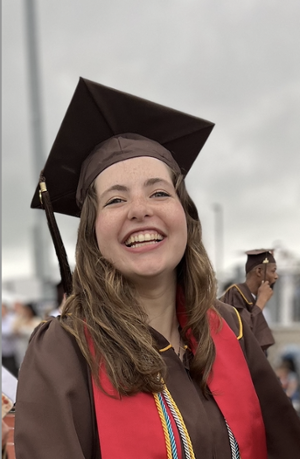
This week’s Project 100+ memory comes from Emily Schmidt. She was born and raised in Jefferson, New Jersey. Her father worked in law enforcement and sales. Her mother raised Emily and her older brother, Ryan. Before Emily and Ryan came along, her mother was a brokerage assistant at Wells Fargo. Emily attended public schools and graduated from Jefferson Township High School in 2021. She enrolled at Rowan University in the Fall of 2021 as a history major and graduated four years later with the history major, a minor in anthropology, a concentration in Honors, and certificates in American Sign Language and public history. She earned the Gary Hunter Medallion for Excellence in History her senior year. Immediately after graduating, she accepted the Edward W. Pells Fellowship in Collections and began a residential period of study and practice at historic Fort Ticonderoga in Ticonderoga, New York. Her main project was the study of 18th century shoe, stock, and knee buckles. This work required much reading in both primary and secondary sources to help her gather the expertise to be able to identify the collection of unidentified buckles. Eventually, she was able to use the art style on the buckles and a variety of other markers to be able to identify many of them. When she presented on this research, her title was “One, Two, Buckle My Shoe.” She completed this internship in August of 2025. Ten days later, she began her graduate study at the University of Delaware, where she is currently working on her master’s degree in history with concentrations in public history and museum studies. In addition to her classes, she is a teaching assistant, which are part of her duties as a fully funded graduate student. This winter, she began serving as a lab director for the Department of Anthropology, a position that she will hold until the work processing the items collected from the site is complete.
*****
My father did not earn a college degree, but my mother and my older brother did, so I can’t remember when I didn’t want to go to college. My first plan was to study American Sign Language (ASL) and become an interpreter. My high school had ASL as an elective course, and I studied the subject for four years. I found it fascinating, and it fit with my long-time desire to help people. During my senior year, my Advanced Placement history teacher, Kasey Farris, took me aside and asked me about my future plans. After I told her what I was thinking, she urged me to consider majoring in history because I had such a passion for the subject. Indeed, I was already thinking at this time about how all the public history sites that I visited with my family were not as welcoming to the deaf as they should be. So, I applied for history programs when it was time. I applied to Bloomsburg University in Pennsylvania and Rowan University. I was fairly confident that I would get into one or both, and I really liked what both colleges were doing with their history programs. Indeed, I was accepted at both. I chose Rowan because it was close to Philadelphia and because of the quality of the faculty in the Department of History. I remember looking up their publications and being really impressed by both how much scholarship they were producing but also by the diverse and interesting subjects that they were researching.
I remember feeling very intimidated after my first two history classes, one was with you on United States History to 1865 and the second was with Scott Morschauser on Western Civilization to 1660. Those classes were very intense, and I look back now on them as a great introduction to the field and great preparation for the future. After I survived those two classes, I was never as worried again about how I would do in a course. These two classes were both in the CLIO program, and that program really helped me because it provided me with friends and peers who were going through the same experiences. These individuals certainly helped me do well in those challenging classes as well as in the challenge of adjusting to living away from home.
In my second semester, I took two more history courses, Historical Methods with Jody Russell Manning and World History since 1500 with Glenn McDorman. Professor Manning’s course was incredibly useful to me. There was much to do, and I emerged with an enhanced ability to streamline everything required of history majors from intensive reading to primary source research to writing.
During the summer after my first year, I took Internship in History with Jen Janofsky, the public historian in the Department. She helped me land a position at the Israel Crane Historic House and WYCA in Montclair, New Jersey. When I returned to Rowan in the Fall, I took Jen Janofsky’s Introduction to Public History and began working directly for Dr. Janofsky at Red Bank Battlefield Park and in the Park’s Whitall House. I loved working there because of my connection to the public. I loved seeing that what I was learning was having a real impact. I really enjoyed interacting with the diverse public that visited our site and being able to adapt to five-year-olds and to octogenarians. Beyond working with the public, working for Dr. Janofsky was truly so great. Despite the fact that she is absolutely brilliant, she always found a way to talk to whatever group she was addressing (whether it was her interns, her students, or the public) in such a way as to be completely understandable. It was such an impressive thing to watch her do this time and time again. I was always learning from her. In addition, she became an amazing personal mentor to me. She was critical to so much of my success and gave me such great professional advice. She recommended that I apply for the Pells Fellowship. I am confident that her recommendation helped secure my current graduate fellowship at Delaware. Even after graduating, she remains so supportive and available.
That same semester, I got involved with the Student History Association and was co-vice president with my colleague, Abbie Ealer, who I met through the CLIO program. In my junior year, I remained an SHA officer, but I became the President of Rowan Center for the Study of the Holocaust, Genocide, and Human Rights (RCHGHR) Student Association. In my senior year, I stepped back a bit but remained Treasurer of RCHGHR. These responsibilities included working with other student run organizations to plan events led by RCHGHR’s executive board on Holocaust and Genocide awareness.
In my sophomore year, I took Ancient Egypt with Scott Morschauser. I had always had an interest in ancient history, so I knew I would enjoy his class. However, he really inspired me to be a better historian in general. His passion for history and his deep, deep knowledge of his subject led me to want to dive even deeper into all the subjects I was studying. He gave me a whole new model and a new level to which to aspire.
I took Introduction to Digital History with Jessica Mack during my sophomore year. I had never really considered using digital sources at any level before. As someone with an interest in public history, her introducing to me these sources was profoundly important. I came to realize how important digital sources and techniques were in research and, especially, in the presentation of history to the wider public. Later, I began working with Dr. Mack outside of class through her Digital Humanities Center, in particular working on a project on the National Women’s Conference. It was an incredible experience. I later took a second course with Dr. Mack on oral history. Not surprisingly, this course expanded my understanding of how historians can use these sources to enlarge the types of stories we explore. The interviews I was able to conduct with the delegates of the National Women’s Conference will always stick with me as these female pioneers were a wealth of knowledge and support for breaking glass ceilings.
In the second part of my sophomore year, I began working as your research assistant on your project on lynching after Reconstruction. By far the highlight of this research was the ten-day road trip that you took several of us on into the South. It was an incredibly fast-paced trip as we visited numerous archives in several different states, including Kentucky, Tennessee, Arkansas, Alabama, Mississippi, and Georgia over the period. Although we had done much research through newspapers on the subject we were studying before departing, it was very powerful to do archival research in the states where so much of the violence took place. Somehow the whole experience made the subject much more real to me. It was certainly holding some of the original documents in my hands, but it was also following that up by driving through some of the very places that we had read about. We also visited the National Memorial for Peace and Justice in Montgomery, Alabama. For someone like myself who is so interested in how one conveys the past to the public, this was fascinating. I think they did such a good job of presenting this very troubling history. Subjects like lynching are so hard to convey without losing the essential humanity of the victims. That trip was another one of my undergraduate experiences that expanded both my ability and my desire to seek out primary sources not easily found in online searches. One more thing about this trip that was so influential on me was the numerous meetings that you arranged with other historians. Most evenings we were sharing dinner with accomplished faculty who you knew through your research and professional career. Research can be a solitary experience, but this demonstrated to me in a clear and concrete way why networking is so important.
I took Senior Seminar in my junior year with Stephen Hague. My paper was on the 1783 Charles Wilson Peale painting entitled “George Washington at the Battle of Princeton.” Seminar was so much fun for me. It was my first time really incorporating material and visual analysis in my historical writing. This was something that I had long wanted to do, and it lived up to my expectations. There had been only two previous scholarly analyses of this painting which required me to seek out different sources to gain a robust understanding of this particular painting. It was challenging but also exhilarating to learn this new approach to source analysis. In the end, I enjoyed this work so much that I decided that I wanted to do similar work in graduate school. I then applied to the Museum Studies and Public Engagement master’s program at the University of Delaware. They accepted me and even gave me a full scholarship that provides both a tuition waiver and a stipend of $27,000 for each of the program’s two years.
That same semester, I took your course on the Civil War and Reconstruction. I was just talking about this class with one of my colleagues the other day. It ended up being one of my favorite classes at Rowan. Despite my interest in US history, I knew so little about the time period before I took the class. The reading pace was intense and so focused on this relatively short period of time that I felt like I really got immersed in the period. I felt like I got so deep that, despite all the limitations that come with studying people who lived so long ago, that I began to grasp how these individuals saw their world and the rapid changes they were experiencing. I also really enjoyed the historiographical essay that I wrote for the class on immigrants serving in the Confederate Army.
In my senior year, I began working with Chris Saladin on his mapping project on ancient Carthage. Right after the Department hired Dr. Saladin, Dr. Mack recommended that I contact him because she knew of both my interest in digital history and my love of the ancient world. He was teaching only remotely in that first semester, but we met over Zoom. I loved everything about his project right from the beginning just as Dr. Mack suspected. I ended up working with him my entire senior year, helping him build up the website, particularly the “Gallery of Ruins” page. This included selecting photographs and developing the metadata for each building. In the Spring semester, I began working on a new map where I began drawing the locations of all these ruins using 20th century archaeological site reports. We used ArcGIS Pro software to do this work. This work with Professor Saladin was so important to me. Not only did I love doing the work itself, but it gave me new skills which I was able to use later on a different project, namely on the Grenadier battalion von Minnigerode who fought at Red Bank Battlefield during the battle of Fort Mercer in 1777. The work on this project led to an essay entitled “Mapping the Minnigerode: Interdisciplinary Methods in DNA Identification from the Red Bank Battlefield Archaeology Project,” which has been accepted for publication as a chapter in a forthcoming volume on historical archaeology and the American Revolution to be published by the University of Tennessee Press later this year or next year.
I am filled with gratitude when I think about my four years at Rowan. My foundation of knowledge is so strong. I was pushed to read and to write and to learn so much in my classes. Perhaps more importantly, I had absolutely amazing experiences outside of the classroom. So many of the faculty went out of their way to involve me in their scholarship and to expose me to the many different aspects of historical research. Now that I am in graduate school and have finished my first semester of demanding courses, I understand even more clearly the value of the training and mentorship that I received at Rowan. Recently, the faculty in the University of Delaware’s Department of Anthropology named me director of one of their archaeology laboratories, one focused on the materials collected from the home and site of George Read, a signer of the Declaration of Independence. Additionally, I am beginning a project in Preventative Conservation at Fort Mifflin through the Winterthur Program in American Material Culture. I am the only graduate student running a lab at this time and one of only two History Masters’ students in the Winterthur course, something that would have never happened without all the amazing support I received from the Department of History.
*****
This is part of the Department of History’s “Project 100+,” an ongoing collection of memories by Glassboro State College and Rowan University alumni and staff that began as part of the celebration of the 100th anniversary of the founding of Glassboro Normal School, later Glassboro State College, and now Rowan University. Thanks to Laurie Lahey for helping proofread and edit the final versions. Email carrigan@rowan.edu with questions or corrections. You can find the Link to all of the Project 100 and Project 100+ entries on the Web: https://www.rowan.edu/ric-edelman-college/departments/history/alumni/