Jesse Kennedy
Jesse Kennedy
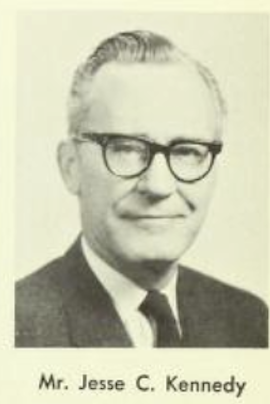
Remembering Jesse C. Kennedy
This entry in “Not Forgotten: Recalling Former Faculty in the Department of History” series is about Jesse C. Kennedy, a member of the Department of Social Studies at Glassboro State College (GSC) in the 1960s. Although only at the College for a relatively short amount of time, Dr. Kennedy made a significant impact on those he taught and on the institution. In particular, those students who attended GSC while he was on the faculty felt that they knew more about the Vietnam War than almost anyone else. For those that attended after he left the faculty, this was no longer the case. This entry focuses not only on his years at GSC but on his very interesting life before and after.
*****
Jesse Carl Kennedy II was born in Harlem, Montana, on November 25, 1918. His parents named him after his father who was about thirty years old at the time of his birth. His mother was Lucy Bosley Kennedy, aged about 25. Jesse was the second child of the Kennedys, two years younger than Myra Nell. Jesse, his parents, and his sister moved to Long Beach in California not long after his birth, but, in 1921, when Jesse was just two years old, his father passed away. Lucy and the family soon moved to Valdosta, Georgia. There she took a job in the public schools and lived with her mother, Antoinette Bosley.
After graduating from high school, Jesse attended the University of Georgia where he earned a bachelor’s degree in agriculture. Four months before Pearl Harbor, he enlisted in the United States Army Air Corps and became a captain during his time in the service. His initial enlistment expired in 1942, but he re-enlisted and served until January 1946.
After his discharge, he moved to Chicago and entered the doctoral program at the University of Chicago. There he studied recent American foreign policy in China and became an expert in Asian history and politics. In Chicago, he also met and married Carolyn Noreen Geisel Scott who had a son named Geoffrey born in 1939. Carolyn possessed a bachelor’s degree from Southern Illinois University and worked as an engineering “draftsman” on the Manhattan Project at the University of Chicago. In due time, Jesse adopted his stepson, who became Geoffrey Kennedy. In his self-penned obituary, Geoffrey referred to Jesse Kennedy as his “adopted/step/emotional” father. In 1947, Carolyn and Jesse had a daughter of their own, Carla McCrae.
While still working on his doctorate, as was common at the time, he took a position as an instructor in the Department of History at his wife’s alma mater, Southern Illinois University in Carbondale. There he taught several courses, including “The Far East to 1912,” “The Far East, 1912-present (1952),” and “The History of Russia.” While teaching at SIU, he also took a position as a newscaster for WIPF, a radio station in Herrin, Illinois. In the Spring of 1955, he resigned his position at SIU, which had a very onerous teaching and grading load at the time, to focus on completing his dissertation. At the same time, he left his part-time position at WIPF for a full-time newscaster position at WBMD, a radio station in Peoria.
In the Fall of 1961, as he neared completion of his dissertation, he returned to the academy, taking a position in the Department of Social Studies at Glassboro State College. At GSC, he taught courses on Asian history and emerged as a respected faculty member on campus and became deeply involved in the local community. He and his family moved into a home at 200 Lakeside Drive in Glassboro. His passion for broadcast continued, and he soon began hosting a radio show for WGLS, “Glassboro Looks Ahead.” By 1964, the Gloucester County Board of Freeholders thought highly enough to name Kennedy one of five members of the Gloucester County Improvement Authority. In the Summer of 1964, he oversaw a project supporting migrant farm workers from Puerto Rico.
During the second half of his first year, in 1962, he and Marius Livingston were the two faculty chaperones on the trip to the United Nations in New York City that led to the formation of Operation Uganda. During the summer of 1962, he, Marius Livingston, and several students travelled to Washington, D.C. to meet with various politicians to seek support for Operation Uganda, including Senator Harrison Williams, Congressman William Cahill, and Sargent Shriver, the first Director of the Peace Corps and President John F. Kennedy’s brother-in-law. That Fall, Kennedy helped host “Uganda Day,” a teach-in on African history and culture and a celebration of Ugandan Independence. In the Spring, he became chairman of the Fundraising Committee for Operation Uganda and assisted as the program collected equipment, supplies, and over 100,000 books to ship to the newly independent country. With the help of the United States Navy and many other volunteers and supporters, the successful project delivered boxes of materials and books to Kampala in the Summer and Fall of 1963. Save for Project Director Marius Livingston and Assistant Director Betty Bowe, no one was more important to Operation Uganda than Jesse Kennedy. As Robert Bole in More Than Cold Stone wrote, the “quintessential event that ignited the Glassboro spirit to its brightest flame was” Operation Uganda. “The genesis of this project can be traced to faculty members Marius Livingston and Jesse Kennedy.”
While Operation Uganda unfolded, in December 1962, he finally finished his dissertation, which when completed was 519 pages in length. Entitled, “American Foreign Policy in China, 1937-1950: An Analysis of Why We Failed,” Kennedy criticized sharply U.S. policy in China. “While we did not lose China, we permitted the National Government to lose China, and in remaining identified too long with the losing cause, we incurred the hostility of the winning side.” Further, he charged that the government was too “inflexible” with the new Chinese government, preventing us from reaching an accommodation and reducing American influence in China to non-existent (pp. 503-504).”
With his doctorate complete, Dr. Kennedy became a full Professor in the Fall of 1964. Although everything seemed set up for him to finish his career at GSC, the United States government asked him to help guide policy in Asia. He took leave from GSC and joined the Human Factors and Operations Research Unit (HFORU), focusing on Korea. Although he initially remained connected to Glassboro State by sending back recorded films from Korea for screening by students, he never returned to the Glassboro campus as a faculty member. In March 1967, his mother died. The record of his activities with HFORU is not readily available, but he eventually left government service and moved to Philadelphia, where he became a career counselor and even an actor, playing “The Doctor” in the 1980 television movie, Big Blonde. Eventually, he moved to live near his son, Geoffrey, in Flint, Michigan. In 1989, he died in Flint at age 71.
*****
Below are a few quotes from interviews that I did with colleagues and alumni who attended while Jesse Kennedy was on the faculty at Glassboro State.
“Jesse C. Kennedy was in the history or social studies department. I don’t know why he left the College, but he was very smart, very knowledgeable, and had a good reputation among the students. Students told me that his courses were interesting, and they clearly enjoyed attending class. In faculty meetings, he was someone that everyone listened to, including myself.” Edward Wolfe, Professor of English Literature, Glassboro State College
“Another important professor was Jesse Kennedy. His courses were fascinating, and he had a great personality.” Mary Olive Gillespie ‘63
“In Dr. Jesse Kennedy’s class on East Asian history, those of us who were social science majors had already discussed the Vietnam war in the context of the sphere of influence political theory. That theory posits that a country should not go to war in a country that is not in its ‘sphere of influence’ where it otherwise does not have a vital interest. In the case of Vietnam, it was clearly in China’s sphere of influence and the United States did not have a vital interest there. The combined impact of Dr. Kennedy’s class and the teach-in had a profound impact on my views and the decisions I made during my years of eligibility for the draft.” David Tarr ‘65
“I had Jesse Kennedy, and I think he taught courses on Soviet Union and world history before Robert Hewsen was hired. I remember that Dr. Kennedy appeared on television. He looked like a professor, and he also smoked a pipe. He was more aloof than the others, but I remember him helping me when I was preparing an oral presentation on the decision to drop the atomic bomb on Japan.” Bob Bakley ‘66
“Jesse Kennedy helped me to understand what was happening in Southeast Asia at a time that our involvement in the Vietnam War there was just ramping up. He did this through his classroom teaching but also by organizing a very early teach-in on the war. For me it led to my coming to oppose the war particularly when I went to graduate school at Kent State University in 1965. I became very active there as I expanded my understanding and built on the knowledge I gained from Dr. Kennedy's class.” Ron Weisberger ‘65
“Jesse Kennedy allowed Marius to take the lead on Operation Uganda, which meant that I didn’t have as many interactions with him as some other students. That is not to say that I did not notice his presence and support of Operation Uganda. I must admit that he was a very good-looking man with a great broadcasting voice.” Betty Bowe Castor ‘63
During my time at Glassboro State in general and my time working on Operation Uganda, one “big moment was a trip to Washington, D.C. in the summer of 1962… I know who drove the car in which I rode. It was Dr. Jesse Kennedy - I remember he was smoking his pipe while driving. I also remember him telling us as we approached Washington that we might get ‘Potomac fever.’ I didn’t know what he meant at first, but after the excitement of meeting our Congressman, William Cahill, I began to understand what he had meant. The most important person that we met on this trip was Sargent Shriver, John F. Kennedy’s brother-in-law and the first Director of the Peace Corps…. I remember our sitting at a table when Sargent Shriver came in. He was well-spoken, nicely dressed, and overall impressive. In that moment, I was overwhelmed with ‘Potomac fever’ as I stared at this person who I had seen on television. He was like a movie star to me, and I think to others in the room as well. We told him what we were doing and why, and that we needed his support. I remember that he loved our plan and that he promised to help us if he could. I believe that he did do things to help us, though he was very busy.” Bob Mossman, ‘64
*****
This is part of a series remembering past faculty members who taught history at the institution that is today Rowan University. Many of the profiles have been made possible by Project 100 and Project 100+ interviews. Thanks to all participants in those projects. Thanks to Laurie Lahey for helping proofread and edit the final versions. Email carrigan@rowan.edu with questions or corrections. You can find the link to the page with all the current profiles here: https://chss.rowan.edu/departments/history/alumni_all/former_faculty.html