Lester Bunce
Lester Bunce
Remembering Lester Bunce
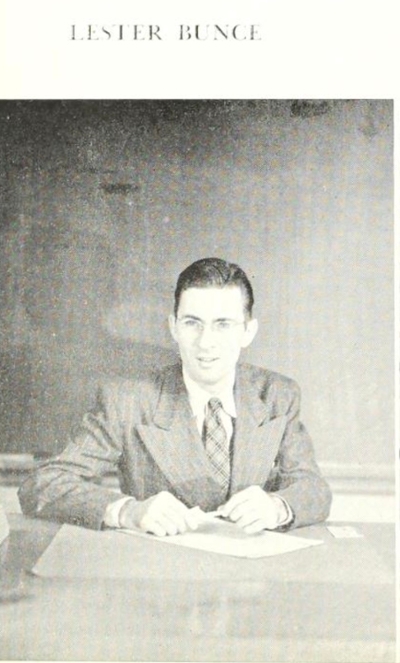
This entry in “Not Forgotten: Recalling Former Faculty in the Department of History” series is about Lester Bunce, a member of the Department of Social Studies at Glassboro State College (GSC) beginning in 1945. He retired from the Department of History in 1976. Quieter than some of his fellow faculty in the Department, such as Harold Wilson, Samuel Witchell, and Marvin Creamer, he nevertheless played an important role in the college for over three decades.
*****
In the Fall of 1945, Lester Bunce joined Glassboro State Teacher’s College to teach history and social studies education courses. Hired by the social studies chairperson Harold Wilson and his father, Edgar F. Bunce, the second President of the College, he was one of the first social studies faculty members hired after a long hiring freeze that began during the Great Depression and lasted through World War II.
Edgar F. Bunce had a long and distinguished career as an educator, serving as a teacher, a principal, a superintendent, and as a college instructor. Before he became the second President of Glassboro State Teacher’s College in 1937, he had served as the State Director of Education in New Jersey for six years. At GSC, he held the College together during the trying period of the Great Depression and World War II when enrollment dropped dramatically. He named his first-born son Lester after his own father.
An experienced teacher, Lester taught at several schools before joining the faculty, including Clayton High School. Born on April 15, 1912, in Lodi, Bergen County, New Jersey, Lester Mory Bunce and his family moved around in New Jersey as his father moved between various teaching and administrative positions. The formative years of his youth took place in Trenton where he developed a love of kayaking. He graduated from Metuchen High School where he played football. According to his brother, he boxed in three fights under a pseudonym. He didn’t pursue this sport further, however, due to his father’s disapproval. His youthful enthusiasm for football, boxing, and kayaking was always combined with a love of reading and a fascination with politics. He attended Trenton State College to pursue the family business of teaching. He saw the field, just as his father did, as a noble profession.
While teaching at the Summit Junior High, Lester met and fell in love with a dynamic and outgoing librarian named Elizabeth Ann Accurso, the daughter of Italian immigrants. On August 17, 1940, they got married. They had their first child, Elizabeth, only nine days after the Pearl Harbor attack. Although he registered for the draft, the government never called for him to serve during World War II. His daughter, Elizabeth, noted that this was due to his having an infant, her, at home.
Over the next several years, he earned his master’s degree from Montclair State College and began teaching at Clayton High School. After he was hired by GSC in 1945, the family settled in Pitman. There, Lester and Elizabeth had two more daughters, Marguerite and Wilma.
Although always a relatively quiet person, Lester was extremely busy and involved in his early days at Glassboro. He taught a wide variety of courses not only in history, but in political science, sociology, and education. For example, he taught American History and Government, Rise of Western Civilization, Europe since 1914, and a two-semester sequence entitled Imperialism and World Politics. He also taught social studies education courses. Outside of the classroom, he was a senior class advisor and President of the Faculty Association.
Lester taught during periods of rapid growth for the College and much expansion. During his time, the College added certification and programs for middle school teaching and later high school teaching. Later, the College began offering liberal arts degrees, such as history, separate from teaching degrees. In his final years on the faculty, the longtime social studies department broke up into the separate departments of History, Sociology, Political Science, Anthropology, and Economics. Lester went with the Department of History and spent his final years teaching Western Civilization survey courses, allowing the newly hired faculty to teach their specialties.
Ina Livingston, the wife of one of the faculty members hired after Lester, recalled his support of her husband, Marius. She remembered him as “friendly and kind. It was easy to see that he truly cared for us. We liked him a lot.”
One of his former students, Marge Jackson (’63), remembered Lester as “low key and gentle… but he had neat little stories that I still remember today. It is strange the things that I recall. For example, I remember him telling us about the high incidence of kidney problems among bus drivers. I also remember him telling us about how teachers were emperors of their classrooms, which led them sometimes to have anxiety on the one day a year they were invaded and observed by their supervisors.”
In 1955, the senior class composed a tribute to him, noting his “quiet, subtle humor” and his always rendered “well-chosen words at class banquets.” The students reported that he had “a steadying hand” and was an “unobtrusive presence” who could nonetheless “pull us out of a difficulty with his slow-talking, clear-thinking arguments.” We appreciated his “comfortable relaxed aura of self-assurance” and his “quantities of thoughtful good advice.”
When he retired from Glassboro State College in 1976, he had been teaching history and social studies for 33 years. Named Professor Emeritus, his friends on the faculty considered him “very much a part of the institution.” His colleague Ben Hitchner said that he “represented and typified the faculty at Glassboro State College when it was the nation’s premier teacher training institution.” He was an “Interdisciplinarian par excellence” and a “moderating influence in the ‘60s.” Hitchner and others noted that his fellow faculty elected him President of the GSC College Faculty Association because of his “good judgment and basic kindness.” Longtime administrator and professor of education Stanton Langworthy said he was an “old worldly professor” and “a quiet man – very gentlemanly and very interested in what students had to say.” Fellow historian Lee Kress was hired three years before Lester retired. As a new faculty member, he remembered that Lester was personally very kind to him. In fact, Lees said that he was always willing to help out his colleagues. He remembered him as “a modest, self-effacing man who was a lovely member of the department.”
Although his physical endurance was impacted by the onset of anemia, which had begun before his retirement, Lester had many good years after retiring. He and his wife, Liz, visited with family and friends. He never stopped reading and talking about politics. His daughter Elizabeth said that reading was his one true joy, and that he “read constantly.” She noted that he “liked novels, [but] he read primarily biographies, particularly those of all the historians.” At the age of 82, on July 24, 1994, he passed away of leukemia. Elizabeth said, “I have always thought of my father as a lovely man. I get very emotional thinking of him. He was a wonderful and supportive father. He was so kind and gentle with all of us. He steered us subtly, but I am quite sure that he is the reason that I look at the world the way that that I do.”
*****
This is part of a series remembering past faculty members who taught history at the institution that is today Rowan University. Many of the profiles have been made possible by Project 100 and Project 100+ interviews. Thanks to all participants in those projects. Thanks to Laurie Lahey for helping proofread and edit the final versions. Email carrigan@rowan.edu with questions or corrections. You can find the link to the page with all the current profiles here: https://www.rowan.edu/ric-edelman-college/departments/history/alumni/former-faculty/