Megan Dakers
Megan Dakers
“No Regrets”: Teacher of Two Continents Megan Dakers Haas (00’) on Studying History at Rowan
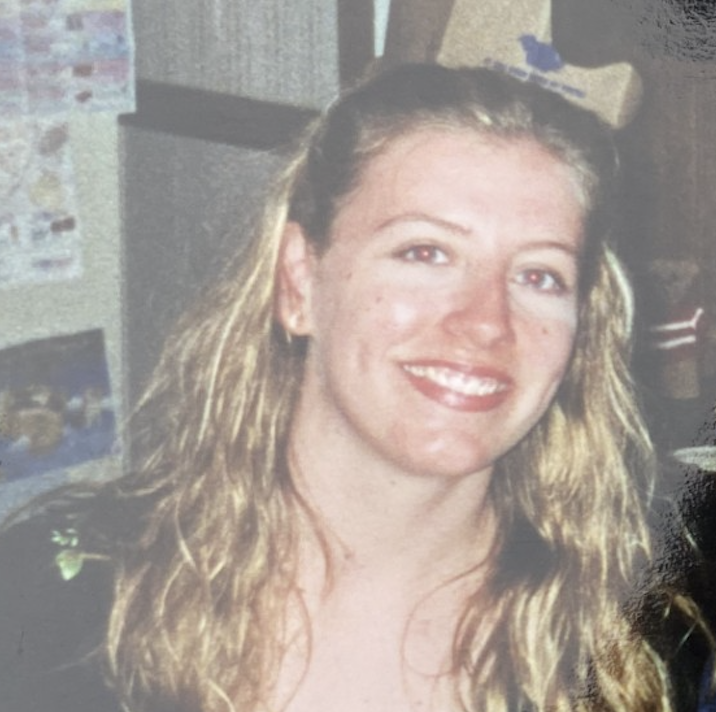
This week’s Project 100+ memory comes from Megan Dakers Haas. She was born in Voorhees. Her family moved around southern New Jersey until Megan was in 7th grade when her family settled in Hammonton. Her parents both worked at Pathmark, a supermarket that no longer exists. Her father, Alan, was a general manager. Her mother, Mary, worked as a store secretary at a different Pathmark. They both continued to work at various Pathmark stores even after their divorce when Megan was five years old. She attended Catholic schools and graduated from St. Joseph’s in Hammonton in 1995. After graduating, she attended Atlantic Cape Community College for two years before transferring to Rowan University in 1997. Three years later, she graduated with majors in history and secondary education. After leaving Rowan, she got a job teaching history at Triton Regional High School. At the same time, she married her high school boyfriend. Her time at Triton lasted longer than the marriage, which ended in 2003. She remained at Triton until 2010. During her time there, she largely taught United States History, but she began team-teaching in an interesting program partnered with the English Department. Her course was called “Western Studies,” and it was paired with an English class that covered similar material at the same time. This course was very interdisciplinary, and it was a special program with select students. They weren’t Honors students, but they were ones that teachers thought would benefit and enjoy the experience. They did all manner of interesting things, such as holding a turn-of-the-century gala where the students dressed in period costume, a “Christmas-around-the-world” fair, and a special unit on genocide that was student-led and culminated with a fundraiser for Doctors without Borders. Megan marks this unit as her greatest accomplishment as a teacher. Her partner in the English Department was Sherrie Erickson, and they became best friends through this work. They remain close to this day. In 2003, she began taking graduate courses in Holocaust and Genocide Studies at Richard Stockton University in Pomona, New Jersey. She took one course at a time and finished it in 2006. She chose to do a thesis, focusing on the East German Secret Police, the Stasi. Due to her husband’s connections, she was able to interview a number of individuals who had direct experience with the Stasi, including one who was detained in a secret prison. In 2006, she got married again, this time to Thomas Haas, a German national. He soon received a green card with a plan to work in the United States, but the flailing economy made that very challenging. After Megan became pregnant, she took maternity leave and moved to Germany. After she gave birth to Sophia, she requested a sabbatical leave to study in Germany. This was granted. After she completed her work studying lesser-known concentration camps, she returned to teaching at Triton, bringing her daughter with her. Thomas was unable to join them at this time. Megan and Sophia returned to Germany for the summer. When administrators told her that she would be transferred to a new school, she decided to resign and relocate to Germany permanently. This was a challenging time for her. She did not know the German language, and it was very hard because Thomas had to travel for his job five days a week. She took an intensive program to learn the German language. After six months, she could communicate finally. Although she still sometimes makes small errors when speaking, she understands German well and has few problems. In 2012, she had twin boys. She focused on raising her three children in the subsequent years. In 2014, she began part-time tutoring of German students in English. In 2017 or so, she opened up her own tutoring business. This went well for a period, but an even better opportunity arose due to a teacher shortage. She thought that she would never teach in a German school because she did not have a German teaching certificate. However, it turned out that she could teach in Germany but on a special contract, one that was year-to-year and paid less than other teachers. Despite her frustrations with these elements, she took the position at IGS Morbach, an institution similar to an American high school with 900 or so students. She has been doing this now for four years.
*****
My parents had no expectations that I would go to college. My father did think that I was bright and told me that I was going to do something with my life. My mother supported me, but she never cared about my grades or what I would do after I graduated high school. However, I always knew that I was going to college. I was very interested in academics and wanted to do well in school. I ended up fourth in my graduating class, even though I think I was a much better student in college and graduate school than in high school. In my senior year, I applied to several schools. I was accepted at LaSalle, which was the school that I most wanted to attend. I am not sure all these years later why I wanted to go there, but I did. I began attending, but it did not actually work out for me. I was having a hard time living away from home and then got into a car accident while driving back to LaSalle after going home one weekend. For me, that was the final sign that this was not the right place for me. With the help of my future father-in-law, I was able to add into courses at Atlantic Cape Community College. I began there as a communications major, hoping for a career in writing. After some time, I reconsidered a career as a writer and began thinking a bit more practically. I began to consider teaching, which I knew from a very young age might be a career for me. After I took my first history course at ACC, I knew that I wanted to teach history. My professor was very young and excited about his subject. His name was Rich Gibbons, and I found the content of his class fascinating. Furthermore, the work, especially the reading and the writing, came easily to me. I can remember reading a book called I, Claudius. I loved it, and I just found all of what I was doing so fascinating. I never wavered from the history major after this course.
After finishing my second year at ACC, I only considered transferring to Rowan. I wanted to go to someplace close, and many students from ACC transferred to Rowan. That first year, I lived on campus in Laurel Hall, but I chose to live at home for the last two years. I did not enjoy living on campus. I was a private person who liked quiet and solitude and did not like parties. On campus life was not a great fit.
I believe that my very first course in the history major was Historical Methods with Herbert Richardson. I don’t remember too much about this course except that I got a C on my first paper, which shocked me. However, I recovered and earned an A.
One of the first history faculty members that I had was Lee Kress for the History of World War II. He was very knowledgeable and very serious. I learned much from him, and he instilled in me a love for the period which I carried over for the rest of my life.
Another faculty member that I had early on was Robert Hewsen for Russian History after 1917. I can remember his opening speech on the very first day. He sat down at the desk and said, “You will come here once a week. I will lecture. You will write down what I say. I will not write on the board. In my experience, most of you will get Cs.” I was completely intimidated. I had never gotten anything lower than an A at ACC. I was worried. True to his word, he spoke for three hours straight and never wrote on the board. There was little discussion with students, but I was able to focus. I was never bored and found what he was saying very interesting. He was so knowledgeable and rarely consulted the notes that he brought to class. After I earned an A for the course, he spoke to me and noted that I had broken the pattern.
On the opposite spectrum was Dick Porterfield who I took for Imperialism and Colonialism. Students used to work hard to get him off subject by bringing up sailing and his boats. True to their hopes, this would distract him and send him off on tangents. In the end, the course was an easy A.
I took Harry Zee for a course on the Holocaust. Like Dr. Kress’s World War II course, this helped shape my long-term interests in genocide and human rights. I took Cory Blake for Arab-Israeli Conflict. This was an area of the world and topic that I knew very little. I remember hoping that I would finally understand this part of the world. Dr. Blake was a very good teacher who knew so much. I surely knew a lot more about the region after the class, but, sadly, I still could not really fathom why the conflict was so intractable.
I also took Janet Lindman for a course entitled The History of Feminism. I really admired and looked up to Dr. Lindman. She introduced me to books, figures, and important things of which I knew too little. I can remember that we had frank discussions of topics that had never come up in any previous class, such as sexuality. She was a strong woman with strong opinions, but she spoke calmly and clearly. She really motivated me, and I left that class determined to continue the struggle for women’s rights.
Finally, in my senior year, you began teaching at Rowan, Dr. Carrigan. I took your Civil War and Reconstruction course. You were different from every other professor. You were young and enthusiastic. You loved the material, but more than this, it was clear that you wanted to connect with us. With most of the other professors, there was a line between students and faculty. You were more of an ally and a partner in learning. With me, I can remember that you noticed my interest in women and the Civil War. You encouraged me to continue with this subject and suggested that I would make a great graduate student. You offered to introduce me to Drew Gilpin Faust and to do whatever you could to help me if I decided to go down that path. I ended up deciding not to do so, but I still remember the confidence you instilled in me by believing that I could earn a doctorate in history. Even though you just came in my senior year, by the time I graduated, I felt we were friends. I invited you to my wedding, and you attended with your wife. Once I became a teacher, my interest in the Civil War endured. I applied for a summer program at Gettysburg College and attended in the Summer of 2001. I learned so much in that program, and I doubt I would have applied for it without your course.
I became very close to three other students during my time at Rowan. I can’t remember now how we all met, but I think I met Dawn O’Leary first. Soon, we became friends with Al Beaver and Andrew Hodslofski. We hung out all the time, both off and on campus. Dawn worked in the Department, and we often came by and hung out while she was working. I can remember spending much time in the conference room. We also spent a lot of time just talking to professors outside of the classroom, often gravitating toward one of our favorites. For me, it was you. For Dawn, it was Dr. Wang. For Andrew, it was Dr. Lindman. Al talked to everyone.
Outside of the Department of History, Mark Myers in Secondary Education was a great teacher. He was very much like you -- young, approachable, and interested in helping each student reach their potential. I loved his classes.
My three years at Rowan shaped me in important ways. I wasn’t a party person, but I made some really good friendships. I still keep in touch with Al and am very sad to have lost contact with Andrew and Dawn. I also had several faculty members that really shaped my future. Together, they cemented my determination to be a teacher. Dr. Lindman changed the way that I saw myself as a woman. Lee Kress, Harry Zee, and you all sparked interests that shaped my teaching and future studies. I have no regrets at all about where I got my bachelor’s degree and think that I got a great education due to the talented and committed faculty.
*****
This is part of the Department of History’s “Project 100+,” an ongoing collection of memories by Glassboro State College and Rowan University alumni and staff that began as part of the celebration of the 100th anniversary of the founding of Glassboro Normal School, later Glassboro State College, and now Rowan University. Due to interest in the project, the number of interviewees continues to grow. Thanks to Laurie Lahey for helping proofread and edit the final versions. Email carrigan@rowan.edu with questions or corrections. You can find the Link to all of the Project 100 and Project 100+ entries on the Web: https://www.rowan.edu/ric-edelman-college/departments/history/alumni/project-100-plus/