Jessica Sciarone
Jessica Sciarone
Jessica Sciarone
 PhD Candidate, Political Science
University of Washington
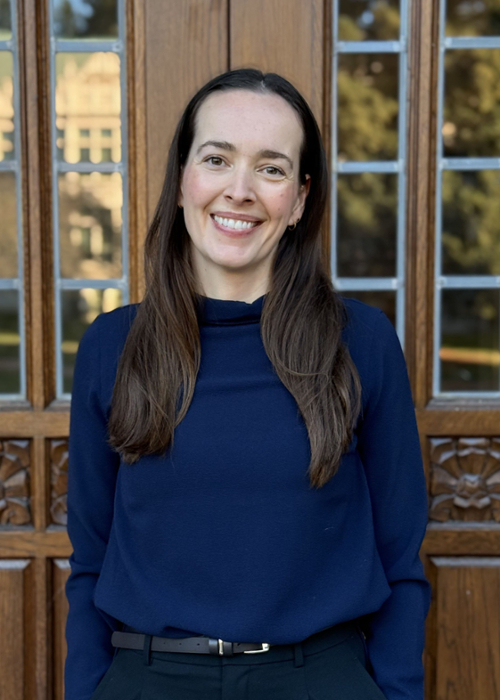
Jessica Sciarone is a PhD candidate in political science at the University of Washington, Seattle. Her research investigates how extremist narratives move from fringe spaces to mainstream political and cultural discourse, with a focus on far-right extremism, conspiratorial thinking, and gendered dynamics. Originally from the Netherlands, she has worked in both academic and non-profit contexts. Before her PhD, she was a researcher at Leiden University, where she studied risk perception following terrorist attacks. She has also worked in the non-profit sector in Seattle. Her work has been published in Terrorism and Political Violence and the Journal for Deradicalization. She holds degrees in Political Science (BSc and MA), Intelligence and International Security (MA) and Crisis and Security Management (MSc).
Interviewer: Mikkel Dack, RCHGHR/History
Can you begin by telling me a bit about yourself—professional background, institutional affiliations, research interests?
I am a PhD candidate in political science at the University of Washington, and currently on the job market. Broadly speaking, my work examines the mainstreaming of extremist ideas, and relatedly, questions of radicalization. My research interests sit at the intersection of political violence, far-right extremism, conspiratorial thinking, and gender.
I am originally from the Netherlands and have been living and working in Seattle since January 2019. I worked in the non-profit sector in Seattle before starting my PhD. Prior to that, I worked as a researcher at Leiden University in the Netherlands, where I worked on projects related to public risk perceptions in response to terrorist attacks, participated in a project on European policies toward returning foreign fighters, and examined the crime-terror nexus. I have degrees in political science (BSc, Radboud University Nijmegen, and MA, University of Washington), Intelligence and International Security (MA, King’s College London), and Crisis and Security Management (MSc, Leiden University).
What is your dissertation research project? What inspired you to pursue this particular topic?
I have always been interested in what shapes people’s worldviews and how they come to see the world in particular ways. In research on radicalization and extremism, it is often difficult to explain why people hold the beliefs that they do: there are a myriad of reasons! Answering that question with full certainty is impossible, but examining what shapes and structures worldviews comes very close.
In earlier work, I examined radicalization pathways and push and pull factors among women who joined or expressed support for far-right extremist movements, as well as women who joined ISIS between 2014 and 2016. This focus on gender was important because, at the time, relatively little attention was paid to how gender shapes the radicalization processes. As a result, gender remains a central aspect of my work. One of the current case studies in my dissertation focuses on incel (involuntary celibates) ideology and extreme misogyny, and how it moves from fringe online spaces into the mainstream, and this is a great segue to talk about my dissertation project.
In my dissertation, titled “Mainstreaming Fringe Beliefs” I shift away somewhat from individuals and instead treat extremist narratives as the object of analysis. In it, I examine how these narratives circulate and gain legitimacy, instead of just focusing on how people come to believe these extremist narratives. I develop a framework that distinguishes between political alignment and cultural alignment. Political alignment refers to the convergence between extremist rhetoric and discourse of political elites. Cultural alignment refers to convergence between extremist rhetoric and widely shared cultural symbols, myths, and nostalgic narratives. I argue that one, or both forms of alignment are present, the mainstreaming of extremist ideas becomes more likely. When extremist narratives are expressed through culturally legible language, they are easier to absorb in everyday life. Similarly, when extremist narratives are echoed by influential political actors, they are normalized at the highest level of public discourse.
How does your research contribute to existing scholarship on ideological extremism?
My research provides a perspective that addresses the role of cultural symbols, myths, and nostalgia in mainstreaming extremist narratives. Existing scholarship often examines these elements within specific ideologies or focuses on how dog whistles and coded language facilitate individual radicalization. My work instead asks how overlap between extremist narratives and widely shared cultural repertoires helps move those narratives into the societal mainstream. When extremist narratives draw on familiar myths, symbols, and nostalgia, they can become embedded in ordinary discourse and are more likely to be seen as common sense, or even reasonable. This process produces a form of normalization that does not require explicit endorsement of extremist ideology; but instead, this process takes on a more subtle approach.
I apply the political and cultural alignment framework across several cases, including incel ideology, the Great Replacement theory, election fraud narratives in the 2020 U.S. presidential election, and environmental conspiracy theories. Across these cases, I examine how different symbolic repertoires and political rhetoric can result in mainstreaming. In my dissertation, I show that cultural symbols, myths, and nostalgia, sources that are typically associated with social cohesion, can be repurposed to legitimize and amplify extremist ideas. I also hope to create a more generalizable explanation for how extremist ideologies move from the fringes of society into mainstream political and cultural discourse.
While your research does not engage directly with the study of de-radicalization, how might your dissertation project contribute to our understanding of the process of countering far-right extremism?
Understanding how extremist narratives become normalized is an important step toward preventing normalization, including in the context of far-right extremism. If we can identify some of these mechanisms, we can better anticipate where and when intervention is possible and needed.
In a recent paper, based on my dissertation dataset of posts on an incel forum, I examine the role of symbols, myths, and nostalgia in relation to deradicalization of incel discourse. While incel ideology can be seen as a belief system in its own right, there are overlapping aspects with far-right extremism and white supremacist discourse, especially in the treatment of race and gender. Incel ideology is increasingly cited as a driver of misogynistic violence, yet its cultural foundations and implications for deradicalization remain underexplored. Analyzing the dataset from the incel forum, I show how incel discourse draws heavily on familiar cultural and nostalgic tropes that frame women in a certain way. Rather than creating a separate incel ideology, this rhetoric adapts widely circulating cultural stories and presents misogynistic claims as culturally legible rather than overtly extremist. All of this is to say, that this has important implications for deradicalization. When grievances are rooted in narratives that circulate far beyond extremist spaces, interventions cannot focus solely on fringe beliefs. They must also engage with broader cultural contexts that normalize misogynistic and exclusionary ideas.
More broadly, all of the case studies in my dissertation examine extremist narratives or conspiracy theories that overlap with far-right belief systems. For example, the Great Replacement theory is part of a broader extremist far-right belief system. So, taken together, my work suggests that counter-extremism efforts require not just counter narratives, but a sustained attention to the cultural narratives that make extremist ideas feel familiar and acceptable.
Can you tell us about your sources base? Where are they located? Have they been accessed by scholars in the past? How are you interpreting them?
My dissertation draws on four primary datasets, three of which I created for individual chapters. For the chapter on incel ideology and extreme misogyny, I use a dataset scraped from incels.is. For the Great Replacement chapter, I analyze four manifestos written by lone actor terrorists. For election fraud narratives, I use Telegram data from twelve channels covering the period of 2019 to 2021, which I collected by setting specific collection parameters. Lastly, for environmental conspiracy theories, I analyze Facebook data from certain Facebook groups, also collected through defined collection parameters.
While all sources are publicly accessible, and have been used by other scholars, the compiled datasets remain original. Across the four cases, I use conventional content analysis. I read each dataset holistically, identify recurring themes and narratives, and then develop coding schemes based on these patterns. I then systematically code the material to examine how specific symbols, myths, and nostalgia are mobilized across different contexts. I interpret the material as part of a larger narrative of the belief system in each of these case studies.
Has your research uncovered anything noteworthy thus far? What have you learned about your topic?
One of the most surprising findings is how rooted some extremist narratives are in mainstream culture. Instead of introducing new ideas, extremist actors frequently rework long-standing cultural myths and symbols, and nostalgic tropes into more radicalized forms. This makes narratives feel intuitive and difficult to challenge, even when they are mobilized in exclusionary or violent ways.
Another important insight is that mainstreaming does not require widespread ideological agreement. Instead, it often occurs through partial adoption or indirect endorsement of specific frames, not an entire conspiracy theory or extreme ideology. This suggests that the boundary between mainstream discourse and extremist discourse is more porous than often assumed.
What do you hope to achieve with your research, both within the academic community and in terms of its impact on society as a whole?
Within the academic community, I hope my work contributes to greater attention to the cultural and narrative dynamics of extremism. Individual radicalization and deradicalization processes are important topics of research but focusing on how extremist ideas and narratives circulate and gain legitimacy can provide additional insight.
Beyond academia, one of my main goals is to help bridge the gap between scholarly research and non-academic communities. There is a lot of expertise in both spaces, but the translation between these two worlds is often difficult. I see teaching as an important part of this work. I am currently developing an undergraduate course on radicalization and extremism, and I will also integrate discussions of media literacy and narrative framing into this course, as well as in the more general courses I teach, such as Introduction to International Relations or Introduction to American Politics.
In its broadest sense, I hope my research contributes to public conversations about how we recognize and respond to harmful narratives before they become normalized.
How do you think future generations of scholars can build on the work you’re doing? What advice do you have for those entering this field?
Future scholars can build on my work by continuing to examine how gender and masculinity shape contemporary extremist narratives. Recent work points to the centrality of masculinity in far-right mobilization and I expect this to remain a major direction for the work.
For those just starting in this area of research, I strongly recommend creating a supportive professional network. Studying terrorism and radicalization often involves exposure to disturbing material, which can feel isolating and affect mental health. Having peers with whom you can discuss the emotional challenges is important. Lastly, it is also important to find ways to create distance from the material when needed.